
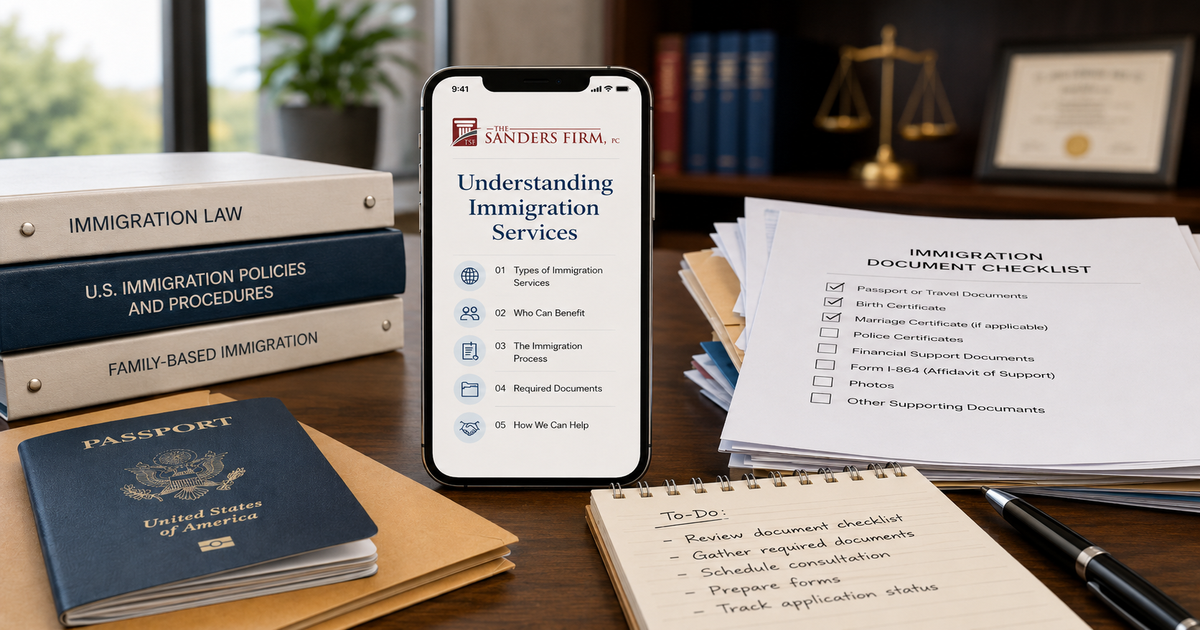
A practical overview of the immigration process, common case types, and why careful legal review matters before filing, responding, or appearing.
Immigration law affects some of the most important parts of a person’s life: family unity, lawful status, work authorization, safety, travel, protection from removal, and the ability to build a long-term future in the United States. Yet many people enter the immigration system without a clear understanding of what immigration services actually involve, which agency controls the process, what documents matter, or how one filing may affect another.
That lack of clarity can create real risk. A person may file a family petition without understanding adjustment eligibility. A green card applicant may prepare for an interview without reviewing prior immigration history. A lawful permanent resident may apply for citizenship without realizing that naturalization can reopen scrutiny of the original green card. A person in removal proceedings may miss a hearing or fail to preserve relief. A survivor of abuse may not know that humanitarian immigration relief may be available. A worker or employer may pursue an employment-based path without reviewing status maintenance, timing, or documentation.
Immigration services should not be reduced to form preparation. Forms matter, but they are only one part of the process. The real work begins with understanding the facts, reviewing the record, identifying risk, selecting the proper legal path, and preparing the documentation needed to support the case.
Immigration Services Are Not One-Size-Fits-All
The immigration system includes many different paths. Some people seek status through family members. Others apply for permanent residence, citizenship, asylum, humanitarian protection, employment-based immigration, waivers, appeals, or defense against removal. Each category has its own rules, evidence requirements, deadlines, procedures, and risks.
Two people may appear to have similar immigration goals but require very different strategies. A spouse of a United States citizen who entered with inspection may be in a different position from a spouse who entered without inspection. A lawful permanent resident applying for citizenship may face different risks depending on travel history, criminal or summons history, tax history, prior filings, and how permanent residence was obtained. A person seeking asylum may need to prove not only fear, but a legally recognized basis for protection supported by credible evidence.
That is why responsible immigration representation begins with review, not assumptions. The question is not simply, “What form do I file?” The better question is, “What does the full record show, and what is the safest lawful path forward?”
Family-Based Immigration
Family-based immigration allows certain United States citizens and lawful permanent residents to petition for qualifying relatives. These cases may involve spouses, parents, children, siblings, fiancés, stepchildren, adopted children, or other qualifying family relationships.
Although family immigration is common, it is not always simple. The government may review the legal relationship, prior marriages, birth records, divorce records, lawful entry, immigration history, prior applications, criminal or summons records, public-charge issues, and whether the beneficiary is eligible to adjust status or must proceed through consular processing.
In marriage-based cases, the government may also examine whether the marriage is bona fide. That may require documentation showing the history and reality of the relationship, including joint financial records, household records, photographs, tax filings, insurance records, travel records, children’s records, and other proof.
A family petition may establish the relationship, but it does not automatically guarantee permanent residence. The beneficiary’s admissibility, status history, and procedural path still require careful review.
Green Cards and Permanent Residence
Permanent residence is a major immigration benefit. It can provide long-term stability, lawful work authorization, greater security, and a pathway to citizenship. But a green card case requires more than eligibility through family, employment, or another qualifying category.
The government may review entry history, current status, prior immigration filings, prior denials, unlawful presence, criminal or summons records, prior removal history, alleged misrepresentation, financial sponsorship, medical-exam requirements, and whether the applicant is admissible.
Some applicants may apply for adjustment of status inside the United States. Others may need consular processing abroad. That distinction is critical. For certain people, leaving the United States may trigger unlawful-presence bars or other admissibility problems. A person should not pursue consular processing without first understanding whether departure creates risk and whether a waiver may be required.
A green card strategy should be built from the record. It should not be based solely on the existence of a qualifying family member, employer, or approved petition.
Citizenship and Naturalization
Naturalization allows eligible lawful permanent residents to become United States citizens. Citizenship can provide voting rights, stronger family-petition options, protection against many removal concerns, and a deeper sense of permanence. But naturalization also invites government review of the applicant’s full immigration history.
Applicants may need to prove continuous residence, physical presence, good moral character, English and civics knowledge unless exempt, and compliance with other eligibility requirements. The government may review travel history, criminal or summons records, tax issues, marital history, child-support obligations, selective-service registration where applicable, and whether the applicant was lawfully admitted for permanent residence.
This is why naturalization should not be filed casually. A person may have had a green card for years and still face questions if the original permanent residence was obtained through a process that now raises concern. Before filing, the applicant should review the green card history, prior applications, travel, tax records, and any criminal or summons history.
Removal and Deportation Defense
Removal proceedings are among the highest-stakes immigration matters. A person placed in proceedings may face loss of status, detention, family separation, loss of work authorization, and removal from the United States.
Removal cases often begin with a Notice to Appear. That document contains the government’s factual allegations and legal charges. It should be reviewed carefully before the respondent admits, denies, or contests anything. Hearing notices, filing deadlines, evidence requirements, and court instructions must be taken seriously. Missing a hearing can result in an in absentia removal order.
Defense may involve contesting removability, seeking cancellation of removal, applying for asylum or withholding of removal, requesting Convention Against Torture protection, pursuing adjustment of status in proceedings, seeking bond, filing motions, requesting prosecutorial discretion, or appealing an adverse decision.
The proper strategy depends on the record: immigration history, family ties, hardship evidence, criminal or summons records, fear of return, prior applications, and available relief.
Asylum and Humanitarian Protection
Asylum and humanitarian protection may be available to persons who fear returning to another country because of persecution, threats, violence, political conflict, religious persecution, social-group membership, gender-based harm, trafficking, government inaction, or other serious danger.
Protection-based claims require careful factual development. A genuine fear is important, but the legal claim must be organized and supported. The applicant may need to explain what happened, why it happened, who caused the harm, whether the government was involved or unable or unwilling to protect, whether internal relocation was possible, and what risk remains.
Evidence may include personal statements, witness declarations, police reports, medical records, photographs, threatening messages, country-conditions materials, political or religious records, news reports, and other corroboration. Prior statements and filings must be reviewed for consistency.
Humanitarian protection may also involve Temporary Protected Status, humanitarian parole, withholding of removal, Convention Against Torture protection, or other relief depending on the circumstances.
VAWA, U Visas, T Visas, and Crime-Victim Relief
Some immigration services focus on protection for survivors of abuse, qualifying crimes, trafficking, exploitation, or coercion. These cases require particular care because the facts may involve trauma, safety concerns, family pressure, workplace exploitation, domestic violence, sexual assault, forced labor, threats, or immigration-related intimidation.
VAWA may provide relief to certain abused spouses, children, or parents of United States citizens or lawful permanent residents. U visas may be available to certain victims of qualifying crimes who were helpful, are helpful, or are likely to be helpful to law enforcement or other qualifying authorities. T visas may be available to certain victims of trafficking.
These cases are evidence-driven. Helpful records may include police reports, court records, protective orders, medical records, counseling records, shelter letters, photographs, text messages, emails, witness statements, employment records, financial records, and personal declarations. Lack of a police report does not automatically defeat every case, but the available evidence must be reviewed carefully.
Employment and Business Immigration
Employment and business immigration may involve workers, professionals, executives, managers, entrepreneurs, employers, investors, or persons seeking lawful work authorization or long-term employment-based immigration planning.
These matters require review of the proposed job, employer documentation, job duties, wages, credentials, licenses, education, experience, status history, prior filings, and timing. Employer willingness alone is not enough. The case must be supported by credible documentation and must fit within the applicant’s immigration status and long-term goals.
A work-authorized strategy should also consider whether the client may later pursue permanent residence, whether family members may be affected, whether status maintenance is an issue, and whether travel or employment changes could create risk.
Waivers and Complex Immigration Problems
Many immigration matters become complicated because of prior unlawful presence, alleged misrepresentation, criminal or summons history, prior removal orders, old denials, inconsistent filings, missing records, or consular-processing problems.
These issues should be reviewed before new filings are submitted. Filing around a known problem rarely solves it. In many cases, the government already has the record, and the issue may surface during an interview, consular appointment, green card review, naturalization application, or removal proceeding.
Some problems may require waivers. Waivers often require proof of qualifying relatives, hardship, family circumstances, medical issues, financial issues, country conditions, rehabilitation, and discretionary factors. Others may require motions, appeals, record correction, or strategic delay until records are obtained.
Complex immigration problems should be confronted directly and carefully.
Appeals, Motions, and Federal Review
An adverse immigration decision does not always end the matter. A denial, removal order, missed hearing, agency error, changed circumstances, or procedural defect may create grounds for further review. Depending on the case, that may involve a USCIS motion, BIA appeal, motion to reopen, motion to reconsider, federal review, or other remedy.
These matters are controlled by deadlines and procedural rules. A person should not wait to review a denial or adverse decision. The first questions are: What decision was issued? What deadline applies? What record did the government rely on? What legal error, factual error, new evidence, lack of notice, or procedural defect may exist?
Appeals and motions should not be filed simply because the result was unfavorable. They should be filed where the record and law provide a viable basis for further review.
Documents Matter
Across immigration services, documents are central. A client should preserve immigration notices, envelopes, passports, visas, I-94 records, green cards, employment authorization documents, prior applications, receipts, approvals, denials, court records, criminal or summons records, family records, tax records, employment records, medical records, and agency correspondence.
The documents tell the story of the case. They show what was filed, what was granted, what was denied, what deadlines exist, and what risks may remain.
Before You Act
Before filing an immigration application, responding to a notice, attending an interview, traveling, appearing in immigration court, or submitting documents to the government, the record should be reviewed.
Immigration services are not only about completing forms. They are about protecting status, preserving options, identifying risk, and preparing a lawful strategy before government action creates consequences.
The better approach is simple: review first, file second.
About the Author
Eric Sanders is the founder and president of The Sanders Firm, P.C., a New York-based law firm focused on civil rights, immigration, employment discrimination, police misconduct, and other high-stakes matters. A retired NYPD officer, he brings a rare inside perspective to the intersection of government power, public institutions, enforcement discretion, and constitutional accountability.
Over more than twenty years, Eric has counseled thousands of clients and handled complex matters involving police use of force, sexual harassment, retaliation, systemic discrimination, immigration consequences, and related civil-rights violations. His immigration practice focuses on family petitions, green cards, citizenship, removal defense, humanitarian protection, waivers, appeals, and complex status issues. He graduated with high honors from Adelphi University and earned his Juris Doctor from St. John’s University School of Law. He is licensed to practice in New York State and in the United States District Courts for the Eastern, Northern, and Southern Districts of New York.
Eric has received the You Can Go to College Committee Foundation Humanitarian Award, The Culvert Chronicles 2016 Man of the Year Award, the NAACP—New York Branch Dr. Benjamin L. Hooks “Keeper of the Flame” Award, and the St. John’s University School of Law BLSA Alumni Service Award. He is widely recognized as a leading New York civil-rights attorney and a prominent voice on evidence-based policing, institutional accountability, equal justice, and rights-based immigration advocacy.