
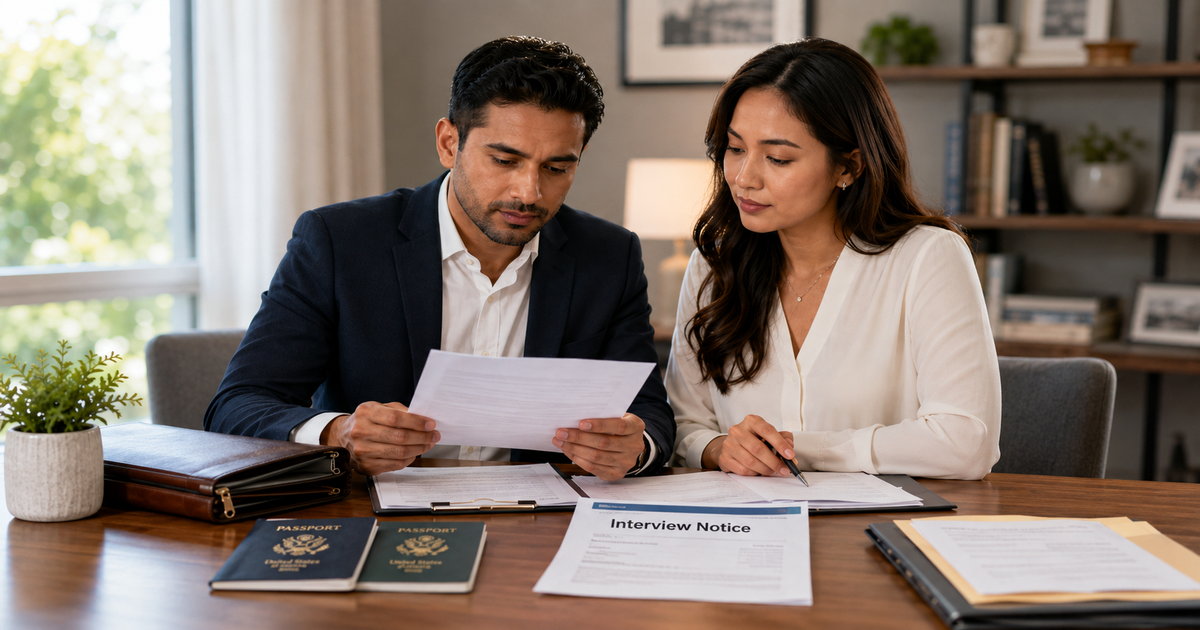
A practical guide to reviewing your record before appearing before immigration authorities.
A green card or naturalization interview should not be treated as a casual appointment. It is a government interview in which immigration officials may review forms, documents, prior filings, travel history, family relationships, criminal or summons records, employment history, tax issues, and the applicant’s eligibility for the benefit requested.
For many applicants, the interview feels like the final step. In some cases, it may be. But the interview is also the point where unresolved issues can surface. A missing document, inconsistent answer, undisclosed arrest, prior immigration filing, old denial, travel problem, or misunderstanding about the application can delay the case, trigger a request for evidence, lead to continued review, or create a denial risk.
Preparation matters because immigration interviews are record-based. The officer is not only listening to what the applicant says during the interview. The officer may be comparing those answers against the application, prior government records, supporting documents, travel history, prior statements, and information already in the immigration file.
The goal of preparation is not to memorize scripted answers. The goal is to understand the record, answer truthfully, bring the proper documents, and identify risk issues before walking into the interview.
Know What Type of Interview You Have
The first step is to identify the type of interview. A green card interview and a naturalization interview are not the same.
A green card interview may involve adjustment of status, marriage-based immigration, family-based permanent residence, employment-based permanent residence, asylum-based adjustment, or another basis for permanent residence. The officer may review the underlying petition, admissibility, relationship evidence, immigration history, medical documentation, financial sponsorship, and whether the applicant is eligible to become a lawful permanent resident.
A naturalization interview focuses on citizenship eligibility. The officer may review the naturalization application, green card history, residence, physical presence, travel, good moral character, English and civics requirements, tax compliance, criminal or summons history, marital history, child-support obligations, and whether the applicant was lawfully admitted for permanent residence.
The notice should be reviewed carefully. It should identify the agency, date, time, location, and documents to bring. If the interview notice includes instructions, those instructions should be followed. Save the notice and bring it to the interview.
Review the Application Before the Interview
Before attending the interview, review the full application that was filed. Do not rely on memory. The officer may ask questions directly from the forms. If a preparer, prior lawyer, family member, or notario helped complete the forms, the applicant should still review every answer before the interview.
For a green card interview, review the petition, adjustment application, affidavit of support, medical-related instructions, work authorization filings, travel filings, and supporting documents. If the case is marriage-based, review the relationship history, addresses, prior marriages, children, joint documents, and any evidence submitted with the application.
For a naturalization interview, review the N-400 carefully. Pay attention to travel history, addresses, employment history, marital history, children, tax issues, criminal or summons questions, organization membership questions, selective-service issues where applicable, and all yes-or-no eligibility questions.
If something on the application is wrong, incomplete, outdated, or misunderstood, that should be addressed before the interview. Some corrections can be made at the interview, but serious issues should be reviewed with counsel before appearing.
Gather the Required Documents
Bring the interview notice, government-issued identification, passport, current immigration documents, and original civil documents where required. Do not assume that copies are enough unless the notice says so. Officers may want to compare original documents against copies already in the file.
For green card interviews, documents may include passports, visas, I-94 records, birth certificates, marriage certificates, divorce decrees, death certificates for prior spouses, adoption or custody records, medical-exam documents if required, tax records, employment records, financial sponsorship documents, prior immigration notices, and proof of current eligibility.
For marriage-based cases, bring updated relationship evidence. This may include joint tax returns, lease or mortgage documents, joint bank records, insurance records, utility bills, photographs, travel records, children’s birth records, shared financial obligations, affidavits, and other documents showing a real marital relationship.
For naturalization interviews, bring the green card, passports covering the relevant period, travel records, tax records, marriage and divorce records, child-support records where applicable, criminal or summons records, certificates of disposition, selective-service records where applicable, and any documents connected to the basis for naturalization.
The documents should be organized. Do not bring a disordered pile of papers. Use folders, tabs, or separate sections so that documents can be located quickly.
Review Travel History
Travel history is important in both green card and naturalization matters.
For green card cases, travel can affect status, entry records, parole, abandonment concerns, and admissibility. If the applicant traveled while an application was pending, the travel documents should be reviewed.
For naturalization cases, travel is often central. The officer may review whether the applicant maintained continuous residence and physical presence in the United States. Long trips, frequent trips, employment abroad, family obligations outside the United States, or unclear travel dates can create questions.
Applicants should review their passports, entry stamps, tickets, travel records, and any personal calendars or records that help confirm dates. If travel listed on the naturalization application is incomplete or inaccurate, the applicant should be prepared to correct the record truthfully.
Do not guess about travel dates if the issue is significant. Travel records should be reconstructed before the interview when possible.
Review Criminal and Summons History
Criminal and summons history must be reviewed carefully before any green card or naturalization interview. Applicants often misunderstand what must be disclosed. They may believe that dismissed cases, sealed cases, violations, summonses, old arrests, adjournments, or cases without jail time do not matter. That assumption can create serious problems.
Immigration forms often ask about arrests, citations, charges, convictions, detentions, and related events. The issue is not only whether the case resulted in a conviction. The issue is what the question asks, what the record shows, and how immigration law treats the underlying event.
For naturalization, criminal or summons history may affect good moral character and may cause the officer to review whether the applicant remains eligible for citizenship. For green card cases, criminal history may affect admissibility, eligibility, waiver needs, or discretionary review.
Applicants should obtain certificates of disposition and related court records before the interview. If the matter was dismissed, sealed, old, or minor, get the record anyway. Do not rely on memory. Do not assume the government cannot see the matter. Do not answer casually.
If there is any criminal or summons history, legal review before the interview is often important.
Review Prior Immigration History
A green card or naturalization interview can bring prior immigration history back into focus. The officer may review past applications, prior denials, visa applications, entries and exits, removal history, asylum filings, prior statements, misrepresentation concerns, or whether the applicant previously received an immigration benefit correctly.
In naturalization cases, this is especially important. Applying for citizenship may cause USCIS to review how the applicant obtained permanent residence. If there were issues in the original green card process, those issues may surface during naturalization.
Applicants should gather prior immigration applications, notices, approvals, denials, interview records if available, and correspondence from USCIS, ICE, CBP, immigration court, the National Visa Center, or a consulate.
If the applicant does not have the prior file and there are concerns about what was filed before, it may be necessary to request records before moving forward.
Prepare for Relationship Questions in Marriage-Based Cases
Marriage-based green card interviews require specific preparation. The officer may ask questions about the relationship, household, daily routines, finances, family members, prior marriages, children, living arrangements, and how the couple met.
The purpose is to determine whether the marriage is bona fide. Real couples can still have difficulty answering questions if they are nervous, unprepared, or disorganized. Preparation should focus on reviewing the relationship history and ensuring that documents are current and accurate.
Couples should review addresses, dates, employment schedules, financial records, travel, major life events, children, prior marriages, and documents submitted with the case. If there are periods of separation, different addresses, limited joint finances, cultural or family complications, or prior immigration concerns, those issues should be reviewed before the interview.
The goal is truthful, clear, consistent testimony supported by documents.
Prepare for the Naturalization Test and Eligibility Review
A naturalization interview usually includes English and civics testing unless the applicant qualifies for an exemption. Applicants should study the civics questions and be prepared to read, write, and answer questions in English where required.
But test preparation is only part of the interview. The officer will also review eligibility. Applicants should be prepared to discuss travel, residence, employment, taxes, family, criminal or summons history, prior immigration history, and the answers on the N-400.
If the applicant needs an accommodation or has a disability-related issue, that should be addressed before the interview. If the applicant may qualify for an English-language exemption based on age and years as a permanent resident, that should be reviewed. If a medical disability exception is involved, the supporting documentation should be complete and properly prepared.
Answer Truthfully and Carefully
At the interview, answers should be truthful, direct, and limited to the question asked. Do not guess. Do not volunteer unnecessary information. Do not argue with the officer. Do not minimize serious issues. Do not deny something simply because it feels embarrassing or old.
If the applicant does not understand a question, the applicant should say so. If an interpreter is present and the interpretation is unclear, the applicant should address that immediately. If the applicant does not remember a date, it is better to say that than to invent one.
Inconsistency can create problems. A truthful answer that is incomplete can also create problems if the question requires more detail. Preparation helps reduce those risks.
Documents to Bring
For green card interviews, bring the interview notice, passports, visas, I-94 records, birth certificates, marriage certificates, divorce records, prior immigration notices, medical-exam materials if required, financial sponsorship documents, tax records, employment records, relationship evidence, criminal or summons records, and updated documents since the filing.
For naturalization interviews, bring the interview notice, green card, passports, travel records, tax records, marriage and divorce records, child-support records, criminal or summons records, selective-service records where applicable, and any documents supporting eligibility or correcting the application.
Bring originals where required, plus organized copies.
Before You Attend the Interview
Do not attend a green card or naturalization interview without reviewing the application, supporting documents, prior immigration history, travel history, and any criminal or summons records. The interview may be routine, but it may also be the moment when unresolved issues become significant.
If the record is clean, preparation makes the interview smoother. If the record contains risk, preparation allows the issue to be addressed before the applicant is questioned under government review.
A green card or naturalization interview is not simply a meeting. It is part of the immigration record. The applicant should walk in prepared, organized, truthful, and aware of the legal issues that may affect the case.
About the Author
Eric Sanders is the founder and president of The Sanders Firm, P.C., a New York-based law firm focused on civil rights, immigration, employment discrimination, police misconduct, and other high-stakes matters. A retired NYPD officer, he brings a rare inside perspective to the intersection of government power, public institutions, enforcement discretion, and constitutional accountability.
Over more than twenty years, Eric has counseled thousands of clients and handled complex matters involving police use of force, sexual harassment, retaliation, systemic discrimination, immigration consequences, and related civil-rights violations. His immigration practice focuses on family petitions, green cards, citizenship, removal defense, humanitarian protection, waivers, appeals, and complex status issues. He graduated with high honors from Adelphi University and earned his Juris Doctor from St. John’s University School of Law. He is licensed to practice in New York State and in the United States District Courts for the Eastern, Northern, and Southern Districts of New York.
Eric has received the You Can Go to College Committee Foundation Humanitarian Award, The Culvert Chronicles 2016 Man of the Year Award, the NAACP—New York Branch Dr. Benjamin L. Hooks “Keeper of the Flame” Award, and the St. John’s University School of Law BLSA Alumni Service Award. He is widely recognized as a leading New York civil-rights attorney and a prominent voice on evidence-based policing, institutional accountability, equal justice, and rights-based immigration advocacy.