
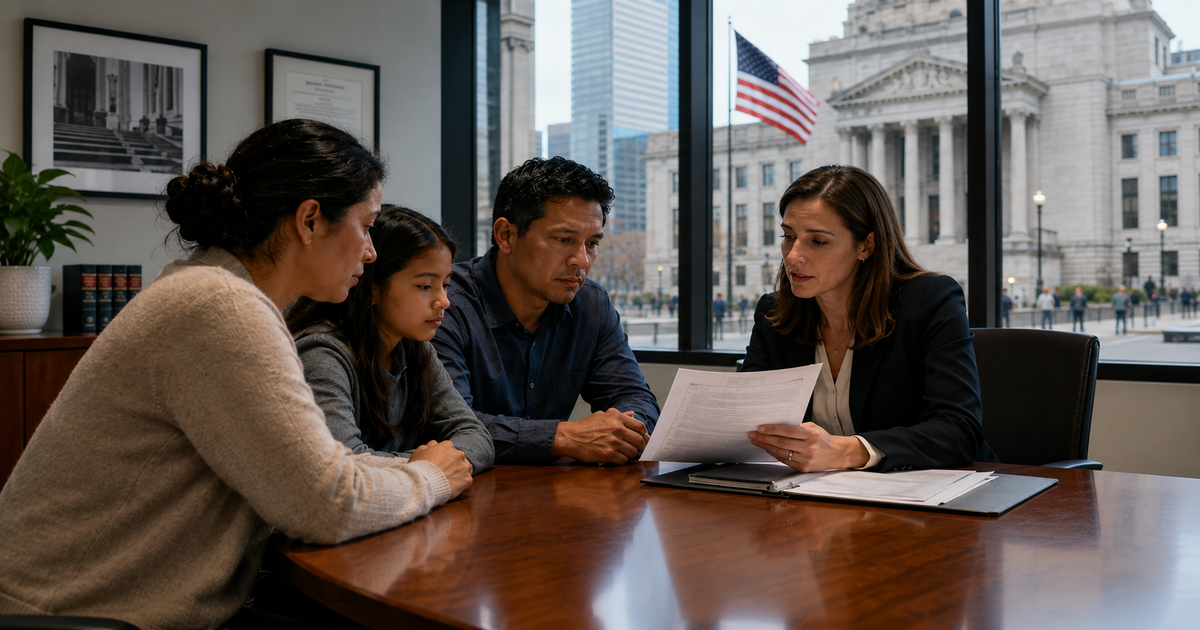
Why some immigration cases are not only about status, petitions, or removal—but about government power, due process, and the unequal treatment of vulnerable people.
Immigration law is often described as a technical area of practice: forms, petitions, interviews, biometrics, waivers, hearings, deadlines, and agency decisions. In one sense, that description is accurate. Much of immigration practice does involve filing systems, eligibility rules, supporting documents, and procedural requirements. But that description becomes incomplete the moment government power begins to operate in a way that goes beyond ordinary adjudication and starts to affect a person’s dignity, liberty, family life, safety, employment, or access to fair process.
At that point, an immigration problem may also become a civil-rights problem.
That shift matters. It changes how the case should be understood. It changes what questions should be asked. It changes what records should be preserved. It changes whether the matter should be viewed only as an immigration filing issue or also as a question of due process, discriminatory treatment, institutional abuse, coercion, retaliation, or denial of equal access to legal protection.
Not every immigration difficulty becomes a civil-rights matter. Delays occur. Forms are rejected. Evidence requests are issued. Interviews are rescheduled. Agencies make mistakes. Those problems, standing alone, do not always create a civil-rights dimension. But where immigration enforcement or adjudication is shaped by arbitrary treatment, discriminatory conduct, coercive pressure, denial of meaningful notice, language barriers, retaliation, prolonged detention, or the misuse of authority, the problem may no longer be merely administrative.
It may instead reflect a deeper question: whether the individual is being treated as a rights-bearing person under law, or as a disposable subject of unchecked governmental power.
That distinction is not theoretical. It appears in real life whenever a person is targeted because of race or perceived nationality, pressured into statements they do not understand, denied meaningful access to counsel, held in conditions that undermine basic dignity, retaliated against for asserting workplace rights, or deprived of a fair chance to present their case because the process itself has become structurally stacked against them.
Immigration Law Is Not Outside the Constitution
One of the most dangerous misconceptions in public discourse is the idea that immigration exists outside ordinary constitutional concern. That is wrong both as a matter of principle and as a matter of practice. Immigration law may involve a separate statutory and regulatory system, but it still operates through government power. That means constitutional values remain central: due process, equal protection principles, protection against arbitrary government action, access to fair proceedings, and freedom from discrimination or unlawful coercion.
When a person appears for an interview, responds to a notice, defends against removal, seeks protection from abuse, or challenges a denial, the immediate issue may appear to be “immigration.” But the surrounding conditions may raise broader questions. Was the person given meaningful notice? Was the proceeding understandable? Was interpretation adequate? Was the person able to obtain counsel? Was the person targeted because of race, language, national origin, or perceived immigration status? Was the person detained in a manner that served process—or punishment? Was government discretion exercised consistently, or selectively? Was an employer using immigration vulnerability to silence complaints or perpetuate exploitation?
These are not abstract concerns. They go to whether the system is operating as a legal process or as an instrument of unchecked pressure.
A rights-based immigration practice therefore requires more than familiarity with forms and deadlines. It requires the ability to recognize when the case has moved into civil-rights territory.
When Process Stops Being Fair
The clearest way immigration problems become civil-rights problems is through the collapse of meaningful process.
Due process is not an ornament. It is what gives legality its structure. A person cannot meaningfully defend a case, respond to a notice, attend a hearing, or prepare for an interview if the person does not understand what is happening, does not receive notice, cannot access records, cannot communicate effectively, or is subjected to rushed, coercive, or opaque decision-making. A legal system without meaningful process is not functioning as a system of rights. It is functioning as a system of control.
This concern arises in many forms. A person may receive a notice they cannot read and do not understand. A family may not realize that failing to appear in immigration court can lead to an in absentia removal order. A detained person may have almost no realistic ability to gather evidence, contact witnesses, or review the government’s file. A survivor of abuse may be unable to explain the basis for protection because language access is poor or trauma is not accounted for in the process. A naturalization applicant may be asked about an old arrest, sealed record, or prior filing without understanding the legal significance of the questioning. A person in removal proceedings may be forced to make decisions before the record is fully reviewed.
At some point, these are not mere procedural inconveniences. They can become substantive deprivations. The injury is not only the outcome. The injury is being denied a meaningful chance to be heard before the outcome is imposed.
That is where immigration counsel must begin asking civil-rights questions.
Discriminatory Enforcement and Selective Treatment
Another point where immigration problems become civil-rights problems is discriminatory enforcement.
The immigration system does not operate in a social vacuum. Decisions are made by institutions, officers, prosecutors, adjudicators, employers, and other actors who are capable—consciously or unconsciously—of treating some populations differently than others. Race, ethnicity, accent, language, religion, gender, and national origin can shape how people are perceived long before any formal legal issue is identified.
A person may be questioned more aggressively because of appearance or language. A worker may be threatened with immigration consequences after complaining about discrimination or unpaid wages. A family may experience greater suspicion because their marriage, household structure, or cultural practices do not fit conventional expectations. A Muslim client, a Black immigrant, a Latino day laborer, or an Asian professional may face different institutional presumptions depending on who is evaluating them and in what context.
Discriminatory conduct does not become lawful simply because it occurs inside an immigration setting. If a person is treated differently because of protected characteristics, if enforcement is selective in a way that reflects bias, or if vulnerability is used as leverage against an already disfavored population, the problem may have crossed from immigration procedure into civil-rights injury.
The issue is not whether every negative immigration decision is discriminatory. The issue is whether unequal treatment, profiling, or selective pressure is shaping the case in a way that deprives the person of fair and equal treatment.
Workplace Exploitation and Immigration Vulnerability
One of the most important and frequently overlooked intersections between immigration law and civil rights appears in the workplace.
Many immigrant workers endure discrimination, retaliation, sexual harassment, wage theft, unsafe conditions, or coercive control because employers believe immigration status—or perceived immigration vulnerability—will keep workers silent. That is not simply an employment issue. It is also a civil-rights issue because vulnerability is being weaponized to strip people of the practical ability to assert rights they otherwise possess.
An employer may threaten to “call immigration” if a worker complains. A supervisor may use lack of status, pending immigration issues, or family vulnerability as leverage to demand silence, loyalty, sexual compliance, unpaid labor, or substandard working conditions. A worker may fear reporting abuse because the threat is not merely job loss. It is exposure to enforcement, family instability, and possible removal.
This is where immigration representation cannot be isolated from broader rights analysis. The legal problem may involve VAWA relief, a U visa, a T visa, or other immigration protections. But it may also involve workplace discrimination, retaliation, trafficking, sexual harassment, or exploitation that should be understood as part of a larger pattern of civil-rights harm.
In these cases, the immigration issue is not separate from the abuse. It is often the mechanism through which the abuse is sustained.
Detention, Liberty, and Human Dignity
Immigration detention is another area where the civil-rights dimension becomes unavoidable.
The moment a person is detained, the case is no longer only about paperwork or eligibility. It becomes a question of liberty. Detention changes everything: access to counsel, access to medical care, ability to gather documents, ability to work, ability to parent, ability to maintain mental stability, and ability to defend the case in a meaningful way. Prolonged or punitive detention conditions may also raise concerns about basic human dignity and the lawful limits of administrative confinement.
A detained immigrant may face barriers that would be unacceptable in other legal contexts: difficulty communicating with counsel, restricted access to family, limited access to records, delayed hearings, medical neglect, or pressure to accept removal simply to end confinement. These are not merely logistical issues. They can distort the fairness of the proceeding itself.
A person held in detention is often expected to litigate a complex immigration matter under conditions that weaken every practical tool needed for self-defense. That reality should not be sanitized. If detention becomes the functional means of coercing surrender, limiting access to legal process, or imposing punishment under the guise of administration, the civil-rights implications are obvious.
Language Access, Disability, and Structural Exclusion
Immigration systems also become civil-rights systems when they fail to accommodate the basic realities of the people moving through them.
A person who does not understand English may not receive meaningful notice if translation is poor or nonexistent. A person with trauma, cognitive limitations, or mental-health conditions may be unable to present facts coherently without appropriate accommodations. A disabled person may face practical exclusion from procedures that assume physical, linguistic, or cognitive ease. A child, elder, or vulnerable adult may be expected to navigate a system designed for sophisticated, document-fluent adults.
In each of these situations, the issue is not sympathy. The issue is access. A legal process that exists in theory but is inaccessible in practice is not meaningfully fair. Language access, disability accommodation, and meaningful comprehension are not secondary matters. They are conditions of real participation.
This is particularly important in asylum, humanitarian, and survivor-based cases, where trauma can affect memory, narrative structure, and the ability to disclose painful events. A system that interprets trauma-related difficulty as deception without accounting for the human realities of persecution, abuse, or exploitation is not merely being strict. It may be reproducing injustice under procedural cover.
Family Separation as More Than a Bureaucratic Consequence
Immigration law frequently affects families. But there is a difference between a system recognizing legal limits and a system treating family separation as administratively expendable.
When parents are detained without realistic access to children, when children lose the daily presence of a caregiver because of procedural breakdown, when spouses are separated because a case was mishandled, delayed, or denied without meaningful review, or when vulnerable households are thrown into crisis because of arbitrary action, the consequences are not merely bureaucratic. They are human, structural, and often foreseeable.
Family unity does not eliminate immigration law, but neither should immigration law become indifferent to its destruction. In many cases, the harm reaches well beyond status. It affects caretaking, education, medical care, emotional stability, financial survival, and the practical exercise of parental and family relationships.
A rights-conscious immigration practice should therefore evaluate not only the filing itself, but the broader family consequences of state action and whether the process is treating those consequences as meaningful.
What Clients Should Preserve When the Case Feels Wrong
When an immigration matter begins to feel less like administration and more like coercion, bias, or institutional unfairness, documentation becomes critical.
Clients should preserve notices, envelopes, interview records, communications, dates of encounters, names of officers where available, detention records, medical records, workplace messages, threats, witness information, audio or written interpretations if relevant, and any documents reflecting the broader context of the problem. If an employer made immigration-related threats, preserve those. If a person was denied language access, document when and how. If a notice was confusing, late, or defective, save it. If a family experienced harmful separation because of the process, preserve the records that show it.
The legal theory often emerges from the documentation. Rights-based advocacy is stronger when the record captures not only what the government decided, but how the person was treated along the way.
The Real Question
The real question in these cases is not simply, “Can this person file something?” The real question is whether the immigration issue exists inside a wider pattern of power, vulnerability, and unequal treatment.
Sometimes the problem is just a filing problem. Sometimes it is an interview problem. Sometimes it is a waiver issue or a records issue. But sometimes the case reveals something deeper: pressure without process, enforcement without fairness, discretion without accountability, or vulnerability being used as a substitute for legal judgment.
That is when immigration problems become civil-rights problems.
And when that happens, the case should be understood for what it is: not only a question of status, but a question of whether the system is honoring the basic promise that law should restrain power rather than excuse its misuse.
About the Author
Eric Sanders is the founder and president of The Sanders Firm, P.C., a New York-based law firm focused on civil rights, immigration, employment discrimination, police misconduct, and other high-stakes matters. A retired NYPD officer, he brings a rare inside perspective to the intersection of government power, public institutions, enforcement discretion, and constitutional accountability.
Over more than twenty years, Eric has counseled thousands of clients and handled complex matters involving police use of force, sexual harassment, retaliation, systemic discrimination, immigration consequences, and related civil-rights violations. His immigration practice focuses on family petitions, green cards, citizenship, removal defense, humanitarian protection, waivers, appeals, and complex status issues. He graduated with high honors from Adelphi University and earned his Juris Doctor from St. John’s University School of Law. He is licensed to practice in New York State and in the United States District Courts for the Eastern, Northern, and Southern Districts of New York.
Eric has received the You Can Go to College Committee Foundation Humanitarian Award, The Culvert Chronicles 2016 Man of the Year Award, the NAACP—New York Branch Dr. Benjamin L. Hooks “Keeper of the Flame” Award, and the St. John’s University School of Law BLSA Alumni Service Award. He is widely recognized as a leading New York civil-rights attorney and a prominent voice on evidence-based policing, institutional accountability, equal justice, and rights-based immigration advocacy.